The Sun Wonât Come Out Tomorrow: The Dark History of American Orphanhood by Martin Kristen
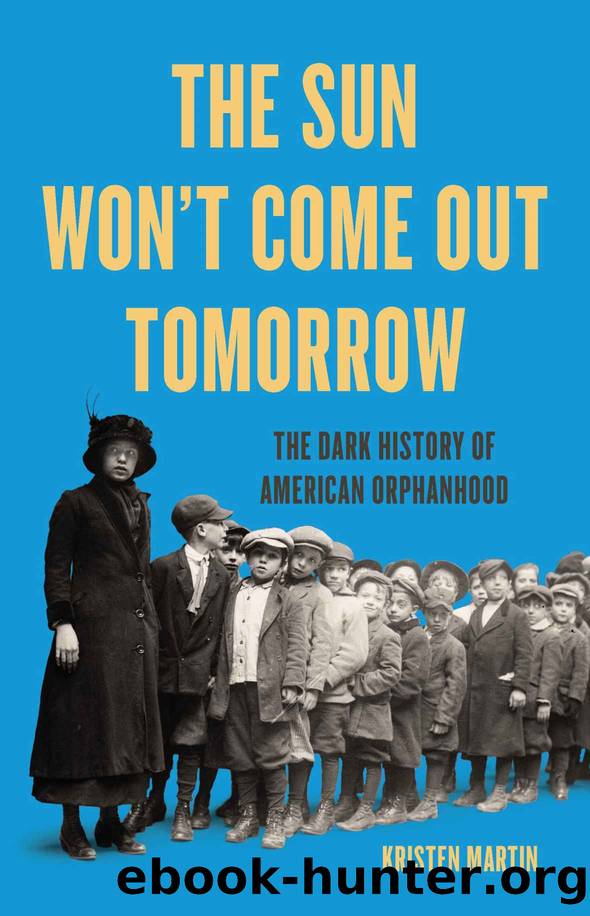
Author:Martin, Kristen
Language: eng
Format: epub
Publisher: PublicAffairs
Published: 2025-01-21T00:00:00+00:00
In the early 1900s, when foster care held promise as a Progressive solution for deinstitutionalizing âorphans,â the federal government created the first agency devoted to child welfare: the Childrenâs Bureau. The bureau had been unanimously proposed at the 1909 White House Conference, but it took eleven introductions of bills calling for its establishment before Congress finally passed one in January 1912; President William Howard Taft signed it into law in April of that year.
The federal governmentâs first bureaucratic and financial foray into taking responsibility for the welfare of all American childrenânot just the Native children whose lives it had long been upendingâthus came 136 years after our countryâs founding. But at its start, the Childrenâs Bureau had limited power.5 The initial budget was only $25,640, and only fifteen people were on staff.6 And by design, the bureau was originally limited to research and reportingânot active policy or grant making to actually change conditions for children. The law that established the bureau called for it to âinvestigate and report upon all matters pertaining to the welfare of children and child life,â especially âinfant mortality, the birth rate, orphanages, juvenile courts, desertion, dangerous occupations, accidents and diseases of children, employment, and legislation affecting children in the several States and Territories.â7 Notably, foster care, which was still in its infancy at the time, was not on the list.
The bureauâs small size, budget, and purchase on power seems related to the fact that it constituted a pink ghetto within the federal government. Women dominated the bureauâs staff from its earliest yearsâJulia Lathrop, a former Hull-House resident, was chief from 1912 to 1921 and prioritized hiring fellow women.8 But even with this leadership, the bureau was caught in the same bind as female-dominated social work: the struggle to prove that its work was indeed professional and not just an extension of maternal instinct.9
Under its second chief, Grace Abbott, another Hull-House alumna, the Childrenâs Bureau began to study and report on foster care, providing guidance for the private and public organizations that oversaw foster placements. In 1923, the Childrenâs Bureau published Foster-Home Care for Dependent Children, with chapters like âThe Essentials of Placement in Free Family Homesâ and âSpecial Problems Involved in Foster-Home Care,â written by experts who primarily worked for private charities.10 The publication also included a history of child placing, which was, in the 1920s, beginning to shift away from crowded orphanages and the haphazard indenture practices of orphan trains to a process that was, at least in theory, driven by the careful science of social casework.
While some experts and legislators were adamantly opposed to the public funding of private sectarian child welfare charities, just as orphanages had been primarily run by such charities, foster care placements were often overseen by them too. Public-private partnerships were unavoidable, since the charities that had long taken on the responsibilities of child welfare were reluctant to give up their powerâand the state and local money they stood to make by continuing to care for vulnerable children. A
Download
This site does not store any files on its server. We only index and link to content provided by other sites. Please contact the content providers to delete copyright contents if any and email us, we'll remove relevant links or contents immediately.
Personalized inhaled bacteriophage therapy for treatment of multidrug-resistant Pseudomonas aeruginosa in cystic fibrosis by unknow(212354)
CONSORT 2025 statement: updated guideline for reporting randomized trials by unknow(102507)
Critical evaluation of the ProfiLER-02 study design and outcomes by Vivek Subbiah & Razelle Kurzrock(102034)
Cardiac gene therapy makes a comeback by Oliver J. Müller & Susanne Hille & Anca Kliesow Remes(101827)
Whisky: Malt Whiskies of Scotland (Collins Little Books) by dominic roskrow(74614)
Unveiling the design rules for tunable emission in graphene quantum dots: A high-throughput TDDFT and machine learning perspective by Şener Özönder & Mustafa Coşkun Özdemir & Caner Ünlü(50995)
A yeast-based oral therapeutic delivers immune checkpoint inhibitors to reduce intestinal tumor burden by unknow(40370)
Covalent hitchhikers guide proteins to the nucleus by Alexander F. Russell & Madeline F. Currie & Champak Chatterjee(40294)
Meet the Authors: Christopher R. Mansfield and Emily R. Derbyshire by Christopher R. Mansfield & Emily R. Derbyshire(40202)
Alkaline-earth metals promote propane dehydrogenation with carbon dioxide through geometric effects: Altering the reaction pathway by unknow(32811)
Induced iron vacancies boosting FeOOH loaded on sustainable Fenton-like collagen fiber membrane for efficient removal of emerging contaminants by unknow(32607)
Efficient electric-field-assisted photochemical conversion of methane to n-propanol exclusively over penetrated TiO2Ti hollow fibers by Guanghui Feng(32527)
Bi2SiO5 nanosheets as piezo-photocatalyst for efficient degradation of 2,4-Dichlorophenol by Hangyu Shi & Yifu Li & Lishan Zhang & Guoguan Liu & Qian Zhang & Xuan Ru & Shan Zhong(32463)
A novel NDIPTA organic heterojunction photocatalyst with built-in electric field for efficient hydrogen production by Jiahui Yang & Baojun Ma & Yongfa Zhu(32437)
Enhanced conversion of methane to liquid-phase oxygenates via hollow ferrite nanotube@horseradish peroxidase based photoenzymatic catalysis by Jun Duan & Shiying Fan & Xinyong Li & Shaomin Liu(32401)
Ordered macroporous superstructure of defective carbon adorned with tiny cobalt sulfide for selective electrocatalytic hydrogenation of cinnamaldehyde by Xiao-Shi Yuan & Sheng-Hua Zhou & San-Mei Wang & Wenbo Wei & Xiaofang Li & Xin-Tao Wu & Qi-Long Zhu(32330)
What's Done in Darkness by Kayla Perrin(27244)
Topological analysis of non-conjugated ethylene oxide cored dendrimers decorated with tetraphenylethylene: Insights from degree-based descriptors using the polynomial approach by A Theertha Nair & D Antony Xavier & Annmaria Baby & S Akhila(26627)
Investigation of mechanical and self-healing properties of hydroxyl-terminated polybutadiene functionalized with 2-ureido-4-pyrimidinone by Mohsen Kazazi & Mehran Hayaty & Ali Mousaviazar(26552)
